Sarah Fortais
Tourist/Explorer, 2012 and 2016
On pages 33-35 of the Apollo 11 Technical Crew Debriefing Document, Neil Armstrong, Mike Collins, and Buzz Aldrin attempt to describe an unidentifiable object resembling an open suitcase moving away from their vessel on their way to the moon. Depending on the instrument used to view it, the object appeared to take on different characteristics and they could only conclude that it did not look like part of the MESA (Modularized Equipment Stowage Assembly) and ‘it wasn’t a cylinder’.
What is the difference between an explorer and a tourist? On the Apollo 11 moon mission, very little.
When Armstrong and Aldrin reached the lunar surface, they stayed for a total of 21 hours and 36 minutes, which included a 7-hour rest period. While there, their objective (aside from the primary objective of landing on the moon and returning to earth) was to document as much as possible. This involved deploying the Early Apollo Scientific Experiments Package (EASEP), taking photographs, and picking up geological material off the ground to take home. The amount of rocks that the astronauts could pick up was dictated by the size of their suitcases and the strict weight allowance of their Lunar Module.
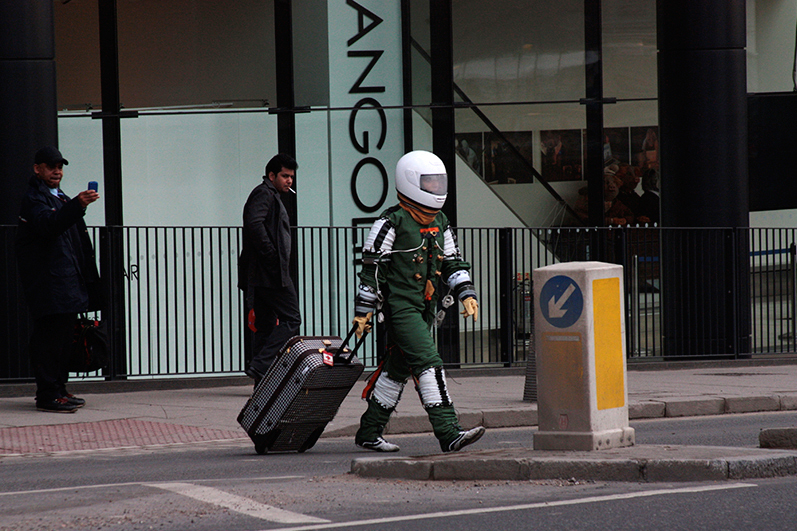
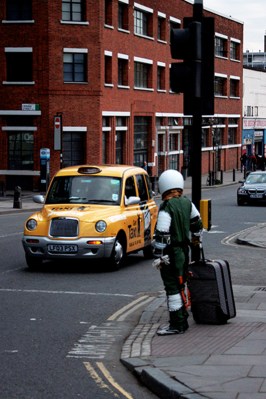
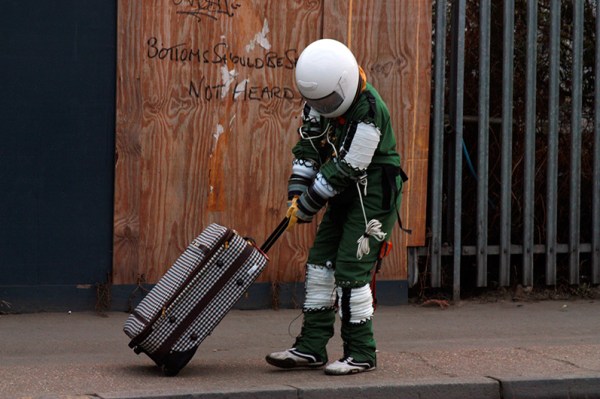
Dressed in my spacesuit in my piece titled, Tourist (2012), I was gathering materials. Some of the objects that I gathered helped me to finish the spacesuit that I was wearing and others were used for future projects. As I collected free materials off the streets – again like the Apollo astronauts – I was limited by the size of my suitcase. In both situations the suitcase performed a greater function than merely being the receptacle to hold collected materials: its size was actually governing what materials were being collected.
As I walked around London in Tourist, my appearance caught people’s attention. My documentation images of this work, that later became framed in Explorer (2016), show myself but also feature the people who watched (and sometimes documented) my journey. I cannot say for certain that I have the world’s only replica A5-L Apollo mission pressure suit built from found materials in London, but the process of gathering materials and building it was a spectacle nonetheless.
When Aldrin and Armstrong landed on the moon, they were tourists at the middle point of a mission that had universally never been done before. As such, their every move, even something as simple as descending a ladder, became a spectacle. Nonetheless, the astronauts were simply doing their job and recovering as much material as possible.
New experiences are often part of a common tourist/explorer experience. This newness is relative to the experience of the tourist/explorer, however. Perhaps then the difference between an explorer and a tourist does not lie in the experience of the person themselves but rather is determined by the prior experience of those who they are made visible to.
–
FIELDWORK DOCUMENTS
IMAGES (all)
Tourist/Explorer. (2012 and 2016)
–
ARTIST
Sarah Fortais
 TSOEG
TSOEG 
You must be logged in to post a comment.